Why STEM Content Is Still Locked Inside PDFs
PDFs show content. They do not understand it.
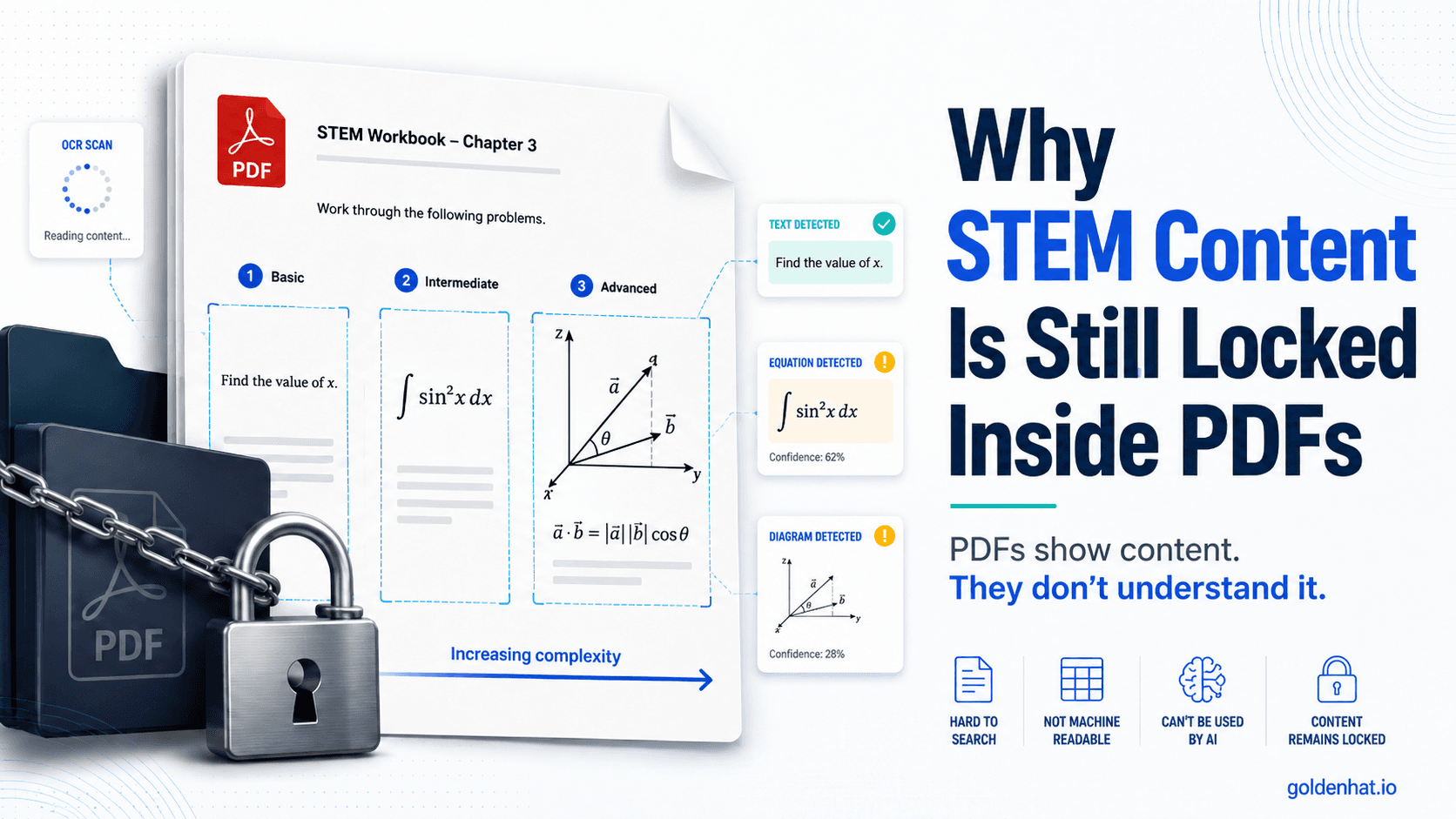
For decades, PDFs have been the standard way of distributing educational content.
Schools use them. Publishers use them. Coaching institutes use them. Students download thousands of them every day.
At first glance, it seems like all this knowledge is already digital.
But there is a problem.
Most STEM content is not truly digitized.
It is trapped inside PDFs.
And the reason is surprisingly simple: a PDF does not understand knowledge. It only knows how to display information on a page.
PDFs Are Presentation, Not Knowledge
When a student opens a PDF, they see questions, equations, diagrams, tables, options, explanations, and answers.
Humans instantly understand the meaning.
Software does not.
A PDF is essentially a collection of visual instructions:
- Put this text here.
- Draw this line there.
- Place this image at these coordinates.
- Use this font and size.
The PDF knows where something appears.
It does not know what it means.
To a PDF viewer, a mathematics question and a restaurant menu are both just elements arranged on a page.
That distinction becomes important when we try to extract or reuse educational content.
A Normal Text PDF Is Very Different from a STEM PDF
Traditional OCR systems were built for documents dominated by plain text.
For example:
The capital of France is Paris.
This is relatively straightforward.
The OCR system identifies characters, groups them into words, then into sentences.
Now consider a mathematics question:
Evaluate the definite integral ∫₀^π x sin(x) dx.
Already, the complexity increases.
There are variables, symbols, formatting, superscripts, and mathematical relationships.
But the real challenge appears when we move into higher-level STEM content.
A question may contain:
- Fractions
- Matrices
- Integrals
- Summations
- Chemical structures
- Geometric figures
- Graphs
- Vector diagrams
At that point, we are no longer dealing with text alone.
We are dealing with structured knowledge.
Why Equations Break Traditional OCR
Let us look at three examples.
Example 1: Simple Text
Find the value of x.
Almost any OCR engine can extract this accurately.
The content is linear.
Words appear one after another.
Example 2: Mathematical Expression
To a student, this is a familiar integral.
To software, it is far more complicated.
The system must understand:
- The integral symbol
- The mathematical function
- The exponent attached to the sine function
- The variable
- The differential operator
Missing even one component changes the meaning entirely.
A small recognition error can produce a completely incorrect equation.
This is why STEM content often requires specialized mathematical recognition rather than standard OCR.
Diagrams Are Even Harder
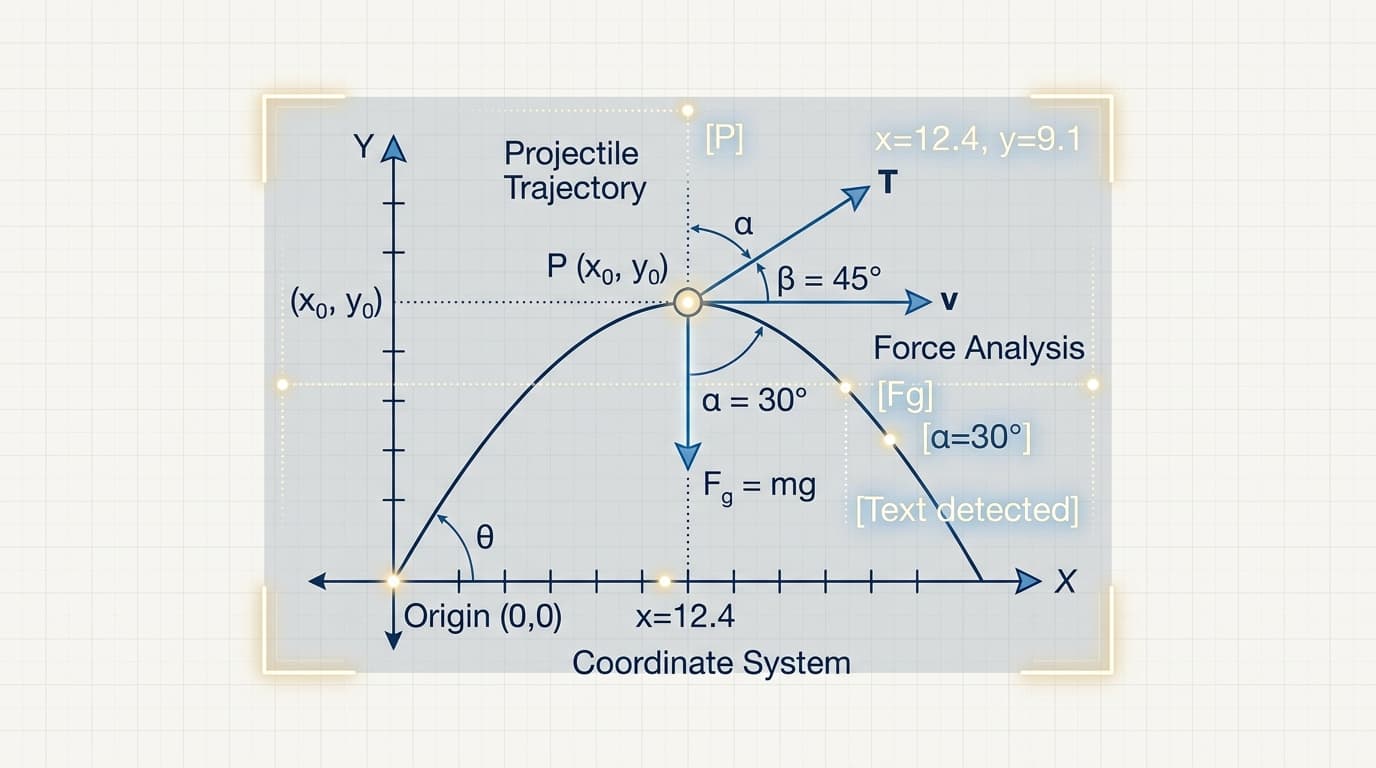
Now consider a vector diagram from a physics or mathematics book.
A student immediately understands:
- Direction
- Magnitude
- Labels
- Relationships between points
- Geometric constraints
Software sees something very different.
It sees:
- Lines
- Curves
- Arrows
- Shapes
- Text labels scattered across a page
Understanding that these visual elements collectively represent a concept is a much harder problem.
Unlike text, diagrams do not follow a simple reading order.
The meaning emerges from the relationship between multiple components.
This is one reason why educational diagrams remain difficult to digitize accurately.
Why Humans Are Still Involved
Many people assume that modern OCR can automatically convert textbooks into structured educational content.
In reality, large amounts of educational publishing still involve human intervention.
After extraction, teams often need to:
- Correct equations
- Rebuild mathematical notation
- Verify diagrams
- Separate questions from answers
- Organize content into chapters and topics
- Restore formatting and structure
The challenge is not simply extracting text.
The challenge is understanding content.
And understanding content requires context.
Humans naturally understand that a particular figure belongs to a question, that an equation is part of a derivation, or that a diagram explains a concept.
Software often struggles with these relationships.
The Real Problem
When we say we want to digitize education, we are not talking about creating PDFs.
That happened years ago.
The real goal is to transform educational content into something computers can understand, search, edit, organize, and reuse.
A question should not merely be an image on a page.
It should become structured knowledge.
The equation should remain an equation.
The diagram should remain a diagram.
The relationship between them should be preserved.
Only then can we build truly intelligent educational systems.
Beyond OCR
OCR is an important first step.
But OCR alone cannot solve the STEM digitization problem.
Educational content contains layers of meaning that go far beyond recognizing characters on a page.
To truly digitize STEM education, we need systems that understand equations, diagrams, relationships, structure, and context—not just pixels.
The future of educational technology will not be built by reading pages. It will be built by understanding them.
Building with complex documents, OCR, AI, or STEM content?
Golden Hat helps founders and teams turn difficult information workflows into reliable software systems.
Talk to us